
Quantum HR enhances HR efficiency through technology integration, managing transformation projects, and providing ongoing support
Quantum HR enhances HR efficiency through technology integration, managing transformation projects, and providing ongoing support
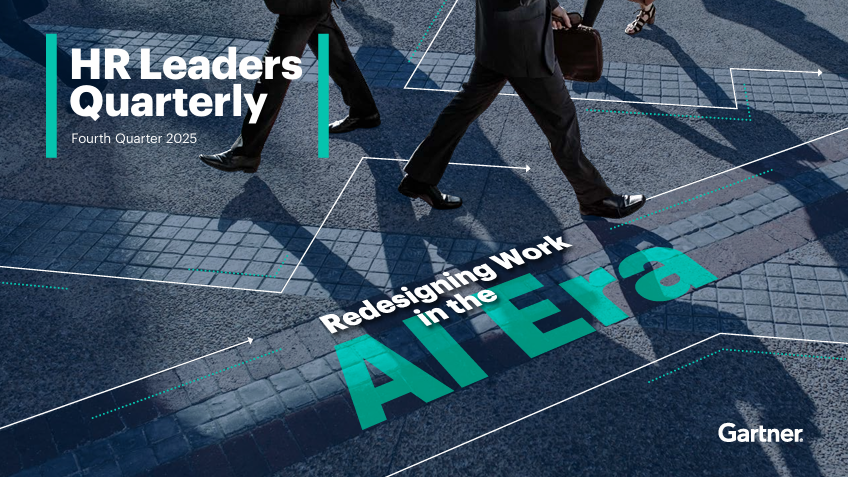
By 2030, HR will not simply be more digital. It will be structurally different.
AI will reshape not only how work is done across organisations, but also how the HR function defines its value, its operating model and its influence. Research in Gartner’s HR Leaders Quarterly (4Q25) explores this shift in depth and highlights a critical reality: HR must evolve from process owner to organisational architect.
The future of HR is not about doing the same work faster. It is about redefining what work HR exists to do.
The Imperative for HR to Become Future-Ready
Many HR teams may feel that years of transformation investment are finally paying off. Automation, analytics and AI promise to reduce administrative burden and generate richer workforce insight. At the same time, AI’s impact across the wider organisation is creating entirely new demands on HR.
However, there is a tension.
AI initiatives often fail because organisations do not change workflows, behaviours or role design sufficiently to unlock value. HR professionals, like the broader workforce, may approach AI defensively, focused on preserving existing responsibilities rather than rethinking them. Meanwhile, operational leaders may bypass HR, assuming it will slow progress rather than enable it.
If HR focuses solely on protecting its current scope, it risks being marginalised. If it focuses only on driving efficiencies within HR itself, it will miss the much larger opportunity to shape how AI transforms the organisation.
The imperative is clear: HR must define its future before others define it for us.
From Process Owner to Capability Architect
By 2030, AI will automate or codify many traditional HR activities. Knowledge that once sat exclusively within HR will be embedded into systems and made directly accessible to managers. Tasks such as workforce planning inputs, learning pathways and elements of recruiting may become partially or fully automated.
This does not eliminate the need for HR. It changes where HR adds differentiated value.
HR’s future impact will be strongest in three areas:
Human behavioural expertise. HR brings structured understanding of motivation, skill development, labour market dynamics and shifting employee expectations. As work changes rapidly, organisations will need deeper behavioural insight, not less.
A multilevel organisational lens. HR often sees second-order effects that other functions miss. A workflow change affects not just productivity but identity, wellbeing and cross-team dynamics. AI-enabled processes will amplify these ripple effects.
Framework design and governance. As decision making becomes more distributed and AI-supported, HR will need to establish the principles, guardrails and parameters that shape thousands of daily workforce decisions.
In other words, HR moves from owning processes to shaping the system within which people and AI operate.
The Rise of “Citizen HR”
A significant shift described in Gartner’s research is the normalisation of what might be called “citizen HR.”
Managers and operational leaders will increasingly:
Rather than resisting this diffusion of HR activity, forward-thinking CHROs will embrace it. The goal is not to centralise every decision within HR. It is to embed people management capability throughout the organisation.
Just as IT evolved to support business technologists rather than monopolise technology decisions, HR must evolve to enable distributed people expertise while maintaining coherence and governance.
A Smaller Function with a Larger Footprint
The 2030 HR function may be leaner in headcount but broader in influence.
As automation and shared services mature, HR may relinquish ownership of some transactional activities. At the same time, HR professionals may move into embedded roles within transformation programmes, business units or cross-functional “fusion teams.”
The shift is not about shrinking HR. It is about expanding its influence beyond formal reporting lines.
Measures of success will also need to change. Instead of focusing primarily on transaction volumes or participation rates, HR will need to track:
Influence, not activity, becomes the metric.
Building the 2030 Operating Model
To prepare, CHROs should begin shaping the operating model now.
This involves assessing where HR technologies are likely to automate or democratise tasks and where this frees capacity for new, higher-value work. It requires partnering beyond HR, especially with IT and transformation leaders, to ensure that AI projects incorporate human design principles from the start.
It also requires investment in new capabilities within HR itself, including product management approaches, AI governance and deeper expertise in organisational design.
Finally, HR leaders must be willing to let go of activities that no longer require central ownership. If HR continues to execute large portions of tasks that AI could codify or managers could handle directly, it will crowd out the capacity needed for emerging strategic demands.
The Risk and the Opportunity
The research is explicit about the risk. If HR fails to clarify its evolving role in an AI-infused workplace, its relevance could diminish.
HR could become a compliance-monitoring function overseeing automated processes, rather than the amplifier and shaper of AI’s benefits.
But the opportunity is far more compelling.
By 2030, HR has the potential to become the architect of how humans and AI collaborate. The function that understands how work redesign affects identity and culture. The function that ensures technology enhances performance without eroding trust. The function that builds antifragile workforce capability in a constantly disrupted world.
The future of HR is not guaranteed. It must be designed.
The question for today’s HR leaders is simple:
Are we preparing to defend our current function, or to redesign it?
Unlock the full potential of your HR with our tailored solutions — explore our services or schedule a free call to get started.
Lorem ipsum dolor sit amet, consectetur adipiscing elit. Suspendisse varius enim in eros elementum tristique.
Quantum HR provides a range of services including Business Process Audits, Transformational Project Management, and Continuous Support & Development. These services help organisations streamline HR practices, implement new technologies, and maintain ongoing digital transformation.
Quantum HR assists organisations by analysing current HR processes, identifying gaps, and implementing technological solutions that automate tasks and improve efficiency. We manage the entire transformation process, ensuring seamless integration and positive user experiences.
Quantum HR primarily works with small to medium-sized organisations across various industries, including the private sector, charity, and publicly funded organisations. Our services are tailored to meet the unique needs of each client.
Quantum HR is unique in its combination of HR expertise and deep understanding of technology. Unlike traditional companies, we focus on digital transformation from an HR perspective, ensuring that technological solutions align perfectly with HR processes and goals.
After implementing new processes or technologies, Quantum HR offers continuous support to ensure these solutions are embedded as the new normal. This includes updates in response to legislative changes, software upgrades, and regular process reviews for continuous improvement.