
Quantum HR enhances HR efficiency through technology integration, managing transformation projects, and providing ongoing support
Quantum HR enhances HR efficiency through technology integration, managing transformation projects, and providing ongoing support
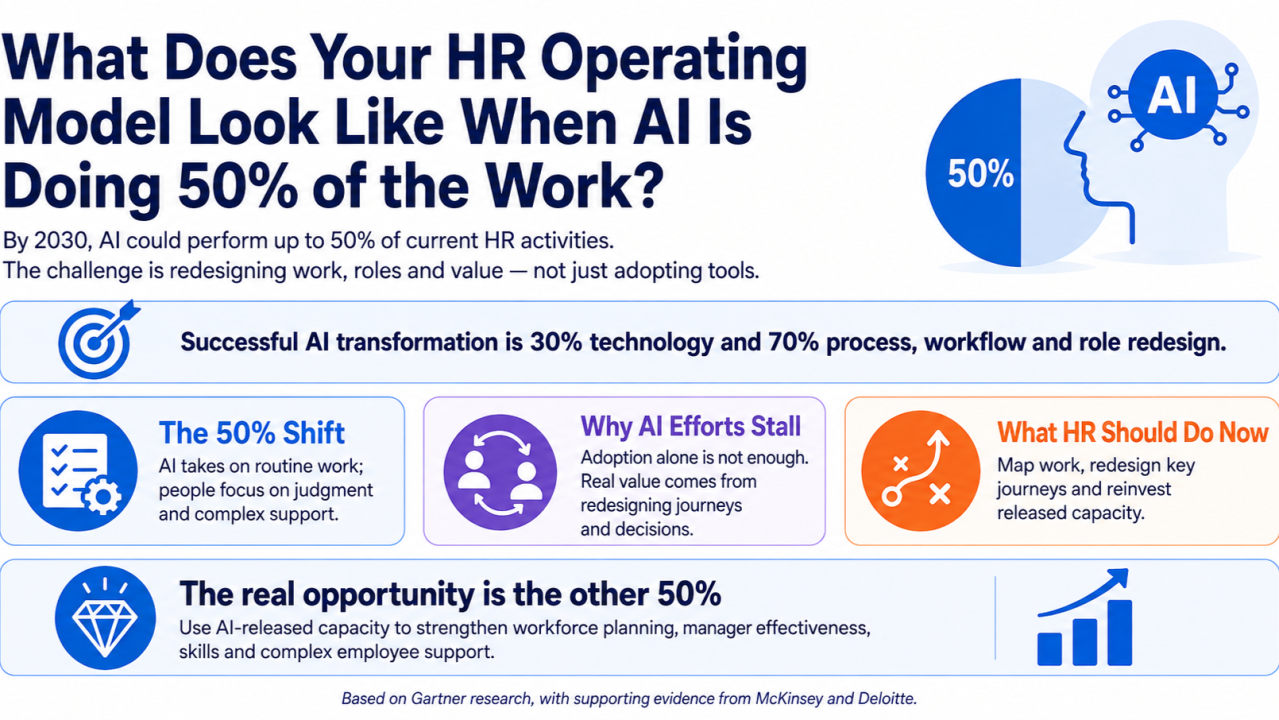
For years, HR transformation has largely meant improving processes: introducing a new platform, moving activities into shared services, standardising policies or giving managers better self-service tools.
AI changes the scale of the question.
Gartner predicts that by 2030, 50% of current HR activities will be automated or performed by AI agents. It expects AI to augment virtually every HR role and task. At the same time, Gartner reports that although AI adoption among CHROs reached 95% by the end of 2025, nearly three-quarters of HR leaders have achieved only moderate or minimal returns from their investments.
The message is clear: adopting AI is not the same as transforming HR.
If AI can perform half of today’s HR work, the opportunity is not simply to make the existing function faster or smaller. It is to reconsider what HR is for, how it creates value and where human expertise will matter most.
The organisations that start answering those questions now will be better positioned to build a HR function that does more than react to change. They will create an evolutionary HR team: one capable of continuously reshaping its work, capabilities and structure as business needs and AI technologies evolve.
The 50% forecast is about work, not necessarily jobs
The prediction that AI could perform 50% of HR activities should not be interpreted as meaning that half of HR jobs will disappear.
Jobs are collections of different tasks. Some are highly repeatable and rules based. Others depend on context, empathy, negotiation, ethical judgment or trusted human relationships.
AI is likely to absorb a growing share of activities such as:
However, the consequences of automation will be distributed across almost every HR role. Rather than eliminating whole jobs cleanly, AI will change the combination of tasks performed within them.
McKinsey describes this as the “messy middle” of automation: work is neither fully automated nor left untouched. Its research suggests that two-thirds of HR processes could be partially or fully automated, but the greater challenge will be redesigning roles and workflows so people and AI can work together effectively.
The key question for HR leaders is therefore not, “Which jobs can we remove?”
It is, “How should work be redistributed between people, AI and managers, and what new value can HR create with the capacity released?”
Technology is only 30% of the transformation
Many organisations are currently adding AI tools to HR processes that were designed for a different era.
A chatbot is placed in front of a fragmented service model. Generative AI is added to an inefficient recruitment process. New analytics are introduced without changing who makes decisions or acts on the insights. Employees receive more self-service options, but the underlying policies remain unnecessarily complex.
These interventions can produce local efficiencies, but they rarely deliver fundamental transformation.
Gartner estimates that successful AI transformation is only 30% dependent on technology. The remaining 70% depends on how effectively the organisation redesigns HR processes, workflows and roles.
This helps explain why widespread experimentation has not yet translated into equally widespread value. Deloitte reports that 84% of companies have not redesigned jobs to accommodate AI, despite high expectations for automation.
AI cannot compensate for an unclear operating model. Applied to a broken process, it may simply enable the organisation to produce poor outcomes more quickly.
Real value emerges when HR redesigns an entire journey around the capabilities of humans and technology. That means removing unnecessary work, connecting previously fragmented activities and establishing clear decision rights before deciding where AI belongs.
The traditional HR operating model is beginning to shift
The familiar HR structure - shared services, centres of excellence and business partners, was created to balance efficiency, specialist expertise and business proximity.
That model will not necessarily disappear, but its components will need to evolve.
HR operations become intelligent digital delivery
Traditional HR operations are built around processing transactions and responding to requests. The future model will increasingly use AI as the front door to HR, resolving routine needs and guiding employees through personalised journeys.
This is more than an improved ticketing system. AI-enabled services can anticipate needs, draw information from multiple systems and complete certain actions rather than simply directing employees to a policy.
The role of the human service team consequently changes. Its value moves toward handling exceptions, resolving sensitive cases, improving journeys and supervising the quality of automated services.
HR business partners become strategic talent leaders
As AI assumes more data gathering, reporting and routine coordination, HR business partners should have greater capacity to address business-critical workforce questions.
Gartner anticipates that the current average ratio of approximately one HR business partner for every 423 employees could eventually rise to between one for every 800 and one for every 1,200 employees in some industries.
That degree of leverage will require more than giving existing HRBPs additional tools. Gartner proposes replacing fixed HRBP arrangements with dynamic pods of strategic talent leaders that can be deployed against the organisation’s most important challenges.
These multidisciplinary teams could combine expertise in workforce strategy, organisational design, skills, analytics, change and employee experience. Their work would be organised around business outcomes rather than permanent functional boundaries.
Centres of excellence become HR product teams
Traditional centres of excellence often develop policies and programmes for the organisation and then hand them to other teams for implementation.
In an AI-enabled model, these groups can evolve into product teams responsible for continuously improving end-to-end workforce experiences.
Instead of owning a programme in isolation, a product team might own the complete experience and outcome associated with joining the organisation, developing a critical skill or becoming a first-time manager. It would use data and employee feedback to improve that experience over time.
The emphasis moves from launching standardised programmes to creating adaptable, increasingly personalised HR products.
More technology should make HR more human
There is an understandable concern that greater automation will make HR more distant and impersonal.
That outcome is possible, but it is not inevitable.
Much of HR’s current capacity is consumed by administration, coordination and the production of information. Automating that work can give HR professionals more time for the activities employees and leaders value most: coaching, problem solving, organisational judgment and meaningful human connection.
The goal should not be to remove people from every interaction. It should be to use people more deliberately where their presence changes the outcome.
Human involvement will remain especially important when a decision:
An effective operating model will make these boundaries explicit. It will define what AI can recommend, what it may decide or execute, when human approval is required and who remains accountable for the outcome.
How HR teams can begin the shift now
HR leaders do not need to predict every future AI capability before acting. They need to create an operating model that can continue adapting as those capabilities develop.
Six moves can establish the foundation.
1. Map work at the task level
Start by identifying where HR capacity is actually spent. Examine tasks, volumes, handoffs, waiting time and outcomes rather than relying only on job descriptions or organisational charts.
Classify the work into four categories: automate, augment, retain as human-led or stop entirely.
This provides a more credible foundation for investment and workforce planning than a list of attractive AI use cases.
2. Redesign complete journeys
Select a small number of high-value journeys, such as recruitment, onboarding or employee support. Redesign each journey from beginning to end before introducing additional technology.
Ask what outcome the journey exists to produce, which steps add value and where human judgment makes a material difference.
3. Establish the human - AI contract
Define the decision rights, controls and escalation points governing AI. Employees and managers should understand when they are interacting with AI, how important decisions are reached and how an outcome can be questioned or reviewed.
Trust must be designed into the operating model rather than added after deployment.
4. Reinvest capacity intentionally
Released capacity does not automatically become strategic capacity.
Before automating work, decide where the time saved will be redirected. Priorities could include strategic workforce planning, manager effectiveness, skills development, organisational design or complex employee support.
Without this decision, automation is likely to become primarily a cost-reduction exercise.
5. Build product, data and AI capabilities inside HR
HR will need people who can operate at the intersection of workforce expertise, technology, data and organisational change.
This does not mean turning every HR professional into a technologist. It means developing enough shared capability to design AI-enabled workflows, evaluate outputs, manage risks and translate workforce challenges into effective products.
6. Adopt a continuous operating-model rhythm
An AI-enabled operating model cannot be treated as a one-time reorganisation.
HR should regularly review which tasks are being performed by people and technology, whether decision rights remain appropriate, how roles are changing and where new risks or opportunities are emerging.
The future HR function will be designed through repeated cycles of experimentation, evidence and adaptation.
The real opportunity is the other 50%
Gartner’s forecast creates a provocative but valuable challenge.
If AI eventually performs 50% of the work currently undertaken by HR, what will the function do with the other 50%?
Will HR continue delivering broadly the same services with fewer people? Or will it use its new capacity to become better at anticipating workforce risks, strengthening managers, building critical skills, improving organisational performance and helping people navigate change?
That choice is ultimately more important than the technology itself.
The evolutionary HR team will not be defined by how many AI tools it deploys. It will be defined by how effectively it combines technological scale with human judgment - and how quickly it can reshape that combination as circumstances change.
The organisations most likely to benefit from AI are therefore not simply those that automate first. They are those that begin redesigning HR’s value, work and capabilities now.
Sources
Gartner statistics and operating-model projections are drawn from “Build an HR Operating Model That Succeeds in the AI Era.”
Supporting evidence is drawn from McKinsey’s research on HR’s dual mandate in the AI era and,
Deloitte’s analysis of human and AI-agent operating models.
Unlock the full potential of your HR with our tailored solutions — explore our services or schedule a free call to get started.
Lorem ipsum dolor sit amet, consectetur adipiscing elit. Suspendisse varius enim in eros elementum tristique.
Quantum HR provides a range of services including Business Process Audits, Transformational Project Management, and Continuous Support & Development. These services help organisations streamline HR practices, implement new technologies, and maintain ongoing digital transformation.
Quantum HR assists organisations by analysing current HR processes, identifying gaps, and implementing technological solutions that automate tasks and improve efficiency. We manage the entire transformation process, ensuring seamless integration and positive user experiences.
Quantum HR primarily works with small to medium-sized organisations across various industries, including the private sector, charity, and publicly funded organisations. Our services are tailored to meet the unique needs of each client.
Quantum HR is unique in its combination of HR expertise and deep understanding of technology. Unlike traditional companies, we focus on digital transformation from an HR perspective, ensuring that technological solutions align perfectly with HR processes and goals.
After implementing new processes or technologies, Quantum HR offers continuous support to ensure these solutions are embedded as the new normal. This includes updates in response to legislative changes, software upgrades, and regular process reviews for continuous improvement.